Did you know that when you search EDUQ.info,you benefit from our specialized educational monitoring work in the field of college education?
«[…] Information monitoring in education is a dynamic process that aims to support your actions. Its success is measured by its ability to fuel your thinking, improve your teaching practices and inform your decisions.»(UQAM — Collimateur, 2026).
The team at the Centre de documentation collégiale (CDC) continuously develops* and enriches its collection through systematic monitoring and partner deposits, including those from the Ministère de l’Enseignement supérieur (MES), the Association québécoise de pédagogie collégiale, and several others. As a result, the collection includes research reports, scholarly articles, conference proceedings, and more, all relevant to teaching and research in college education.
So, how can you take full advantage of the richness of the collection?
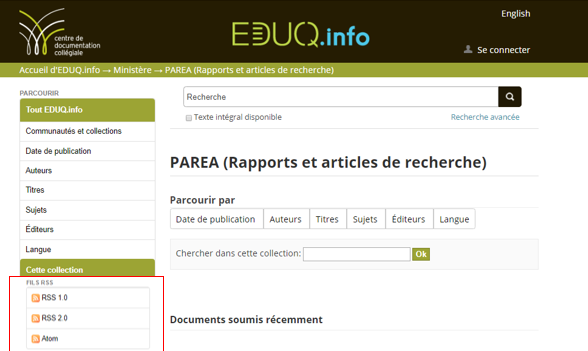
You can of course rely on the basic search box or the advanced search to find the information you’re looking for. But to stay informed and not miss a thing, why not subscribe to our RSS feeds? They allow you to automatically follow new publications in your areas of interest: PAREA and PREP research reports, theses, dissertations and essays, scholarly articles, articles from the Pédagogie collégiale journal, and much more.
In EDUQ.info, each “Community” (association or organization) and each of their “collections” has its own RSS feed.
Step 1: Locate the RSS feed
An example for the PAREA Research Reports Collection:
Step 2: Copy and paste the RSS feed into a monitoring tool
Once the link has been identified, simply add it by copying and pasting it into a monitoring or watch tool— such as an RSS feed aggregator (e.g., Inoreader) or even directly into Outlook.
In this way, keeping an eye on what’s new on EDUQ.info means staying up to date with the latest publications in college‑level education.
Feel free to contact the CDC team to help identify additional monitoring sources in college education: info@cdc.qc.ca
The Centre de documentation collégiale (CDC) makes all research reports funded by the Ministery of Higher Education’s PAREA and PREP programs available on EDUQ.info.
Browse this year’s publications and explore other works by the same authors — all in one place.
Are you familiar with the documentary services available to you within the college network? And which service best meets your needs?
The college network offers two complementary types of documentary services: college libraries and the Centre de documentation collégiale (CDC). College libraries serve the students and staff of the institutions they are part of. Their collections are tailored to the disciplines taught at each institution and their services are designed to meet the needs of the local academic community. The CDC, on the other hand, provides a specialized collection and services focused on college-level education. It supports teaching, professional, and administrative staff across the entire college network, regardless of their institutional affiliation.
To know more about the complementarities, Read the Article [in french]
The CDC team is pleased to introduce two new thematic guides to documentary resources. These additions complement the six initial guides published in the spring and are now available in the “How to Search“ section of the Help page on our website.
Discover how the CDC team monitors and selects articles from scientific journals in education and college teaching disciplines, university theses and dissertations, studies, surveys or any other relevant document produced by reliable sources, and how you can find these relevant publications, grouped together in one EDUQ.info Collection,Sélection de l’équipe du CDC (Documentary selection from the CDC team).
This issue of the College Documentation Bulletin gives the floor to three committed authors who present certain concepts related to the indigenization and decolonization of curricula and pedagogies in college. In addition to the introduction below, the three proposed essays explore different facets of the subject in addition to an invitation to action and contain resources to go further.
The CDC team also invites you to consult the publications on the subject of Indigenous students; or more broadly the subject of Indigenous peoples in EDUQ.info.
( In French ) Depuis la fin des années 1970, plusieurs programmes de financement soutiennent la recherche pédagogique au collégial. Le Centre de documentation collégiale (CDC) conserve et diffuse sur EDUQ.info plus de 500 rapports de recherche issus de ces initiatives.
rétrospective des programmes de financement de la recherche
Plusieurs programmes se sont succédé depuis les débuts du financement de la recherche pédagogique au collégial. Cliquez sur le nom du programme pour explorer les rapports disponibles sur EDUQ.info:
À découvrir: les premiers pas de la recherche collégiale
Avant 1978, les résultats des projets de recherche subventionnés étaient rarement diffusés ou seulement partiellement. Cependant, le CDC a pu en rassembler plusieurs dans sa collection, dont ce rapport publié en 1973.¹
En 1978, le Ministère a établi une nouvelle règle demandant que les rapports soient imprimés à 250 exemplaires. Ce rapport, un des premiers se conformant à cette exigeance, s’est vendu à 11 000 exemplaires.¹
En 1987, le ministère de l’Éducation instaure le Prix du ministre pour la recherche. Ce rapport est le premier à s’être vu décerné ce prix.¹
Explorer la recherche collégiale par thématique
La recherche au collégial porte souvent sur des sujets spécifiques aux disciplines, mais s’intéresse aussi à des problématiques pédagogiques plus générales. Découvrez quelques unes des recherches publiées sur EDUQ.info, selon leur thématique principale:
Repérer la recherche collégiale sur EDUQ.info
Depuis la page d’accueil d’EDUQ.info, vous pouvez accéder de différentes manières aux documents de la collection du CDC, dont les rapports de recherche.
Les rapports PREP se trouvent dans Association des collèges privés du Québec (ACPQ) et les autres dans Ministère de l’Enseignement Supérieur (MES).
◾ Effectuer une recherche avancée dans l’ensemble des rapports de recherche
Pour rechercher dans l’ensemble des rapports disponibles en version numérique, utilisez l’option Recherche avancée puis Ajouter des limites. Configurez les limites indiquées ci-contre ou utilisez ce lien. Au besoin, ajoutez des critères (par sujet, auteur, date, etc.) pour affiner votre recherche. Pour en savoir plus sur la recherche dans EDUQ.info, consultez le guide Utiliser EDUQ.info.
Participer à la recherche collégiale
Pour en savoir plus sur les programmes de recherche et subventions offerts aux chercheurs du collégial, consultez la page Recherche au collégial du Gouvernement du Québec. Vous y retrouverez notamment les guides des subventions du PAREA et du PREP.
Thanks to an agreement negotiated by the Association pour la recherche au collégial (ARC), you can access certain Quebec university library resources, on site, by getting a PBUQ Card – an interuniversity loan card – (formerly known as a green card CREPUQ card, or BCI Card) from the Bureau de coopération interuniversitaire (BCI), that is now the Partenariat des bibliothèques universitaires du Québec (PBUQ).
What are the privileges of instructor-researchers and researchers in the college network? You can borrow books from Quebec universities, most of the time in the same way as undergraduate students do. With regard to accessing databases (scientific articles, etc.) or borrowing e-books, some university libraries provide on-site access to certain databases if a request is made at the library Information Desk. For the time being, no library provides remote access to its digital resources; you must borrow in person. There are special agreements between certain Cegeps and universities; you can find out from your college or Cegep librarians, or from the university itself at the library Information Desk.
How do I get a card? Submit a letter (email) of authorization to the BCI, signed by the Academic Dean of your college or Cegep or by the Administration of your College Centre for the Transfer of Technologies (CCTT).
To simplify the process, a single letter/email may be used to for all applicants from the same establishment.
#NEW ADDRESS (2024-12-16) : Send the email to info@pbuq.ca.
Here is a template for the email (French only):
Par la présente, j’autorise [indiquer le nom de la personne], [indiquer le statut ou le titre de la personne] au sein de notre établissement, à présenter une demande d’utilisation des services des bibliothèques universitaires dans le cadre de ses recherches, et ce, selon les termes de l’Entente sur la réciprocité du privilège d’emprunt direct de documents dans les bibliothèques universitaires québécoises et canadiennes. Je vous saurais donc gré d’émettre à son nom une carte BCI et de la lui poster à l’adresse [du collège ou du centre] que vous trouverez ci-dessous.
[Signature de la Direction des études| ou Direction du CCTT]
How do I renew my card? The procedure is the same as for the initial application: a letter of authorization to the BCI, signed by the Academic Dean of your college or Cegep or by the Administration of your College Centre for the Transfer of Technologies (CCTT). To simplify the process, a single letter may be used to for all applicants from the same establishment.
The CDC team announces a modification of the offer in connection with access to scientific literature in education:
As of April 2023, we are promoting open access publications and we are offering personalized access, adapted to the needs of each practitioner or researcher.
The “Digital Resources” section of the website explains this change and the new ways to do it.
The entire CDC team is mobilized to support you in your documentary research, do not hesitate to contact us: info@cdc.qc.ca